Friday, August 22, 2008

Coffee and the heart - friend or foe?


A new study conducted on Swedish women has found that drinking coffee might not increase the risk of having a heart attack. On the contrary, it might actually be protective for the heart.

The truth of the matter is that reports regarding this relationship of coffee and heart are mixed and conflicting.

Some would say that occasional drinkers are the ones at high risk of heart attack.

http://www.heartzine.com/512-Coffee-Does-Not-Add-to-Heart-Attack-Risk.html

http://www.heartzine.com/411-Occasional-Coffee-Can-Cause-Heart-Attack.html

Monday, July 21, 2008

FURIOUS FIVE

after 7 quizes in physio, here are the FURIOUS FIVE
1. Ngo
2. Nicolasora
3. Ogacion
4. Gaitano
5. Lim

Tuesday, July 1, 2008

diffusion


Diffusion - the process by which molecules spread from areas of high concentratiion, to areas of low concentration.
When the molecules are even throughout a space - it is called EQUILIBRIUM
Concentration gradient - a difference between concentrations in a space.

How molecules distribute itself in microcirculation. Transfer of substances in three compartments: intracellualry and extracellularly( interstitial and intravascularly).

http://highered.mcgraw-hill.com/sites/0072495855/student_view0/chapter2/animation__how_diffusion_works.html

http://highered.mcgraw-hill.com/sites/0072495855/student_view0/chapter2/animation__how_osmosis_works.html

what creates the pressure? It is kinetic motion of of particles that exert the pressure as it collide against each other in a give compartment.

Watch and try answering some questions

http://www.chm.davidson.edu/ChemistryApplets/KineticMolecularTheory/Pressure.html

Friday, June 27, 2008

body tissue

Tissue is a group of cells that have similar structure and that function together as a unit. A nonliving material, called the intercellular matrix, fills the spaces between the cells. This may be abundant in some tissues and minimal in others. The intercellular matrix may contain special substances such as salts and fibers that are unique to a specific tissue and gives that tissue distinctive characteristics. There are four main tissue types in the body: epithelial, connective, muscle, and nervous. Each is designed for specific functions. Use the hyperlinks below to branch into a tissue type and learn more about the topic.
Epithelial Tissue
Connective Tissue
Muscle Tissue
Nervous Tissue

Tuesday, April 15, 2008

lose weight? know your BMR first

Basic metabolic requirement is the energy expenditure your body requires to sustain life while resting.. sleeping for instance will burn 1kcal/min. So 6 hrs of sleeping will need 396 calories.
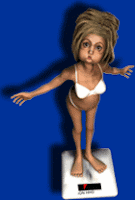
As one gets older there is a corresponding decrease in BMR, thus the reason why they also gain more weight. That is if there is no corresponding adjustment to their caloric intake. But wait, it doesn't mean you have to starve yourself !

You can increase your BMR while maintaining those caloric intake! Having that cake and eat it too! So how? Excercise! If one walks to a distance of 3.5 miles in one hour, you birn 300+kcal. You double the distnce by running or joggin in the same duration of 1 hour and you lose 800+kcalories!


A pound of fat is equivalent to 3,500 calories. So expenditure of the same amount of calories will lose you a pound of fat. Combination of increased physical activity and caloric restriction is the best way to lose those excessive pondage of fat. Eat 500 calories less/day and increase energy expenditure by excercise. Its healthier too!


So, first try to know your BMR by the calculator in this link below
Weight watchers should be concern with the kind of food they take cause it is far more difficult to burn those calories. A peanut butter sandwich (2 tbsp) taken for instance would take you 5 miles or one hour of walking to burn.
know your ideal weight too by this calculator http://www.healthstatus.com/calculate/iwc
The calories you burn would depend on your weight ,the kind and intensity level of activity you are doing. Know the calories burned in some of the activity.
calories in foods
A typical pinoy breakfast of eggs, toccino, sausage maybe bacon and matching fried rice would easily give you 1000-1500kcal early in the day.

Monday, April 14, 2008

cell therapy in capsule?

cell therapy started with implantation of parathyroid tissue to a patient who's parathyroid glands were inadvertently removed some 80 years ago!

how effective is cell therapy?

Using stem cells to replaced damaged tissues has a very promising medical applications. In fact it is being used now in treatment of some incurable diseases like spinal cord injuries, muscular disorders and diseases of blood. But most of these are in their experimental stages.

And now there is even a preparation in capsule form. This bioactive capsule contains MFIII.

The so called MFIII, which is known as the 'rolls-royce' of food supplement is being used as anti-anging and cell regenerating therapies. Unlike other cell therapy this one is taken from sheep cells. Why sheep's embryonic cell?
http://www.extendlife.com/livecell.html

http://www.mf3usa.com/?gclid=CKj26dux2ZICFRVxTAodqBd47g

http://www.mf3usa.com/how.htm

Monday, April 7, 2008

muscle twitch

http://lessons.harveyproject.org/development/muscle/twitch~1.htm

we don't need to kill frogs now in order to know and understand muscle twitch. sometime we wasted frog's life then learned nothing from it. that's tragic!
playing with muscle twitch in this website, we should have the picture of the myofilamints in our minds. it would also help if one will go back to the topic of skeletal muscle contraction which was posted here somtime ago.
the role of calcium ion is highlighted by this experiment.

Wednesday, April 2, 2008

top 5 in physio finals

1. Usero 84.11%
2. Melchor 82.94%
3. Woo 82.94%
4. Rivera 81. 76%
5. King 79.41%

Sunday, March 30, 2008

slide on excitation of skeletal m

Excitation of skeletal muscle contraction
Events occruing after action potential reached the terminal nerve
calcium channel opens
influx of calcium ions
calcium serve as attractant to the vesicles
fusion of vesicles to the neural membrane
release of actylcholine by exocytosis
acetylcholine opens the acetylcholine gated channel
effects of acetylcholine
acetylcholine attaches to the channel
conformational change open the ionic channel
allows Na ions to pass thru the channel
creates an end plate potential
excitation of the skeletal muscle fiber
destruction of acetylcholine
acetylcholinesterase
diffusion out of synaptic cleft
its removal prevents muscle re-excitation
safety factor for the transmission at the nmj
Each impulse at the NMJ is 3-4 times as much end
plate potential needed to stimulate the muscle
fiber - high SAFETY FACTOR

Stimulation greater than 100 times/sec. for several
mins. diminishes the number of vesicles at each
impulse – FATIGUE
drugs that affect transmission at the nmj
A. drugs that stimulate the muscle fiber by
acetylcholine-like action
1. metacholine
2. carbachol
3 nicotine
-difference is they are not destroyed by
acetylcholinesterase
-prolonged action can cause: SPASM
B. drugs that block transmission at the NMJ
curareform drugs – D-tubocurarine

- competes with actylcholine for the receptor sites
- prevents passage of impulse from endplate into the
muscle
C. drugs that stimulate the NMJ by inactivating
acetylcholinesterase
1. neostigmine
2. physostigmine
3. diisopropyl fluorophosphate
- inactivate cholinesterase at the synapses
- accumulation of acetylcholine
- can cause repetitive stimulation of muscle fiber
§ MUSCULAR SPASM
Myasthenia gravis
Paralysis is due to inability of the NMJ to transmit signal
from nerve to muscle fiber
Pathology: antibodies attack the acetylcholine-gated
transport protein
Patient may die of paralysis of respiratory muscles
Treatment:
neostigmine
Allow acetylcholine to accumulate
Excitation contraction coupling
action potential will have to penetrate all the myofibrils
transmission of the action potential from surface to myofibrils
is facilitated by transverse tubules
T tubule action potential cause the sarcoplasmic reticulum to
release calcium ion
Calcium ion then diffuse to the myofibril and binds with
troponin C
calcium pump
Muscular contraction will continue as long as the calcium ions remain high in concentration in sarcoplasmic fluid
Calcium pump -pumps calcium back the sarcoplasmic tubules
Calsequestrin - can bind calcium over 40 times

Tuesday, March 25, 2008

micropatho

You need to understand the immune system its classification and how it works. Then review your understanding of the hemodynamics of the microcirculation at cellular level. good luck

Friday, March 7, 2008

To live longer, drink and exercise

Drinking is healthy,
exercise is healthy,
and doing a little of both is even healthier,
Danish researchers say

A study done on 12,000+ individuals followed up for 20 years . Moderate drinkers with moderate exercise are 30% better off in their survival than teetotallers.

People who had the lowest risk of dying from any cause were physically active, moderate drinkers while those at highest risk were the physically inactive, heavy drinkers, the study found.

http://uk.reuters.com/article/topNews/idUKL0871640820080109?
feedType=RSS&feedName=topNews

what is moderate drinking, what is moderate and vigorous exercises?
http://www.newsmax.com/health/drinking_exercise_keys/2008/01/09/62932.html

Sunday, March 2, 2008

viral infection- a parasitic infestation


This is not sea urchin.
This is Human immunodeficiency virus.Viruses in general unlike bacteria are packages or capsules of genetic material.
They require living hosts — such as people, plants or animals — to multiply and survive.
When a virus enters your body, it invades some of your cells and takes over the cell machinery, redirecting it to produce the virus. The virus may eventually kill the host cells.

Viruses could either be DNA or RNA virus. Once inside the host cell it could insert its viral genome to the host's nucleus and use its nuclear apparatus to reproduce and multiply. The infected cell usually dies because the virus keeps it from performing its normal functions. When it dies, the cell releases new viruses, which go on to infect other cells.


fusion of T lymphocyte and HIV mechanism
see HIV attacking the T cell in youtube http://www.youtube.com/watch?v=RO8MP3wMvqg&feature=related
I just wonder what happens to the regulatory processes -splicing and proof-reading in the transcriptin process..can anybody help?