Monday, June 24, 2013

tutorial on types of tissue


this is a tutorial on different tissues and be able to take the self-evaluation test at the end of the tutorial...have fun and learn


http://www.zoology.ubc.ca/~biomania/tutorial/tuthisto/intro.htm


click me

histology tutorial

learn the different types of tissue thru this tutorial link
take the histology practical exam - if you can do it here you'll do it in our practical exam

http://www.okc.cc.ok.us/deanderson/dennis-tutorial/histologydef.html

http://www.gwc.maricopa.edu/class/bio201/histoprc/prac1q.htm

Sunday, June 23, 2013

where did ATP come from? find out

Photobucket

How Cells Make ATP
by PHOSPHORYLATION... adding a phosphate to ADP ADP + P ------> ATP

a) substrate level phosphorylation...
where a substrate molecule ( X-p ) donates its P to ADP making ATP b) chemiosmosis - [Oxidative Phosphorylation of Krebs cycle & ETC]... food substrates donate e- & protons to acceptor molecules [NADH], i.e., oxidation. NADH gives up electrons & protons are pumped out of mitochondria (or the chloroplasts in photosynthesis); protons diffuse back into mito thru an enzyme - ATPase, the ATPase enzyme makes ADP + P --> ATP figure * c) photophosphorylation.... e- of light energy, instead of food covalent bonds, are captured by chlorophylls to make a proton gradient across the chloroplast membranes... figure* protons move through a chloroplast ATPase enzyme to make ATP

http://student.ccbcmd.edu/biotutorials/energy/chemios.html

Oxidative Metabolism... (cell respiration) occurs in heterotrophic organisms that consume foods ... we say organisms oxidize (consume) foods (often glucose) to make energy because they remove & capture electrons... ... where is energy in foods? it's in the covalent bonds (e-)
Thus - METABOLISM is cells capturing e- via REDOX reactions REDOX REACTION... e- passed from one molecule to another [PGAL --> NAD+] in a chemical rx energy is transferred into the new molecule (a reeox couple) by holding e- OXIDATION = removal of electron &/or proton from food covalent bond REDUCTION = gaining electron &/or proton; adds an electron to an acceptor molecule

Cell RESPIRATION...


a more complete definition of cell respiration : - series of enzyme rx's (biochemical pathways) in the cytoplasm & mitochondria that, - remove e- (oxidation) from covalent bonds of substrates (as glucose), and - pass e- to acceptor molecules [coenzymes] such as NAD+ & FAD* which become reduced [ NADH & FADH2 ] - the reduced coenzymes [ NADH & FADH2 ] pass e- to other acceptors... a series of protein electron carriers called cytochromes, - the electron carriers [cytochromes] pass e- to O2 --reduction--> H2O - cytochromes also pump protons [H+] out of mitochondria into peri-mito space, - protons move back into mito thru a special enzyme (ATPase) & make ATP

KEY Reactions of KREBS CYCLE 1. NAD is reduced (NADH) and FAD is reduced (FADH2) 2. substrate level phosphorylation occurs (GTP <--> ATP) 3. decarboxylation [-COOH] 4.* an acylation reaction via coenzyme-A (forms Acetyl-coA) SUMMARY Reactions: [Krebs Cycle Quicktime Movie*] Summary figure full cycle*

tutorial on membrane potential

membrane potential tutorial

click here

sequence of events here

cellular transport tutorial

Photobucket


http://www.wiley.com/legacy/college/boyer/0470003790/animations/membrane_transport/membrane_transport.htm

http://www.wiley.com/legacy/college/boyer/0470003790/animations/membrane_transport/membrane_transport.htm


Friday, June 21, 2013

study this picture showing fluid compartments fo the body

.


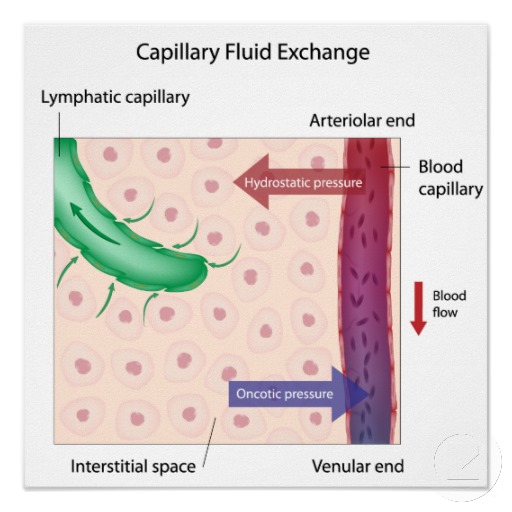
Microcirculation is the delivery of fresh blood to the smallest blood vessels, present in the vasculature embedded within organ tissues.Arterioles carry the blood to the capillaries. Blood flows out of the capillaries into the venules. Arterioles contract and relax, varying their diameter and vascular tone, as the vascular smooth muscle responds to diverse stimuli.The term capillary exchange refers to all exchanges at microcirculatory level, most of which occurs in the capillaries. Sites where material exchange occurs between the blood and tissues are the capillaries. Capillary walls allow the free flow of almost every substance in plasma except plasma protein.Diffusion is the first and most important mechanism that allows the flow of small molecules across capillaries. The process depends on the difference of gradients between the interstitium  and blood. The Starling equation is an equation that describes the roles of hydrostatic and osmotic  forces (the so-called Starling forces) in the movement of fluid acrosscapillary endothelium.

Thursday, May 16, 2013

DR. JUAN MIGUEL MURILLO Dean PT SPU


Congratulations! A true blooded paulinian has taken the PT domain of SPU.
Graduated 2001 PT from SPU. Took up medicine and graduated from WVSU the year 2006. Now a pediatrician.

Saturday, April 20, 2013

attention micro special class

study both gm+ and gm- organisms.. diseases,signs, symptoms 
antibiotics...classification..mechanisms of action
viruses...common diseases
fluid and hemodynamic derangement
neoplasm

Monday, April 1, 2013

SPU PT GRADS LIVING THEIR DREAMS

Dranreb Espura 2001, Las Vegas Nevada
Vanessa Espura 2002, Chicago, Illinois
Geordan Eula 2003,Taunton, Somerset

onalyn Paguntalan-Barbecho.2003 Eugene, Oregon
Carmela Ann Gilpo
2006 New York City
April Jane Corros
2002Gig Harbor, Washington
Joanna cadiz,2004, new york
Francis Raymund Jarangue 2000, Federal way Washington
Cherry Diaz-Estilo 2000, Waynesville, Wisconsin
Tanya Jardeleza
Gazella Vagilidad-Abdallah, 2005, New York
Aileen Sandoval, 2000 wa
Margaret Aguil Antiquiera. 2005 Mt. Vernon Wa
Diana Barrios, 2003, New York
ria Geinah Labanero. 2004. Mt. Vernon, WA
Karla Co, 2005, Florida
Mary Joy Rivero, 2000, PA

Anjanette Ang, 2000, Seattle, WA

Paul Raymund Evidente, 2001, PA
Mary Catherine Anas, 2000, California
Glenn aricaya,2002,Seattle ,WA.

John Caesar Tapiculin,2000,New York & Filamae Garnica, 2000, Florida
Mark Jamantoc, 2002, Seattle WA

Stephanie Jo Depositar,Carilion Stonewall Hosp
Lexington, Virginia


Monday, March 25, 2013

membrane potential- what is it?

membrane potential is but the negative electrical charge inside the cell brought about by the difference in ionic concentration in and out of the cell. This again is due to the selective permeability of the membrane to these ions.
http://bcs.whfreeman.com/thelifewire/content/chp44/4401s.swf

Sunday, March 24, 2013

principle of diffusion

How molecules distribute itself in microcirculation. Transfer of substances in three compartments: intracellualry and extracellularly( interstitial and intravascularly).

http://highered.mcgraw-hill.com/sites/0072495855/student_view0/chapter2/animation__how_diffusion_works.html

http://highered.mcgraw-hill.com/sites/0072495855/student_view0/chapter2/animation__how_osmosis_works.html

what creates the pressure? It is kinetic motion of of particles that exert the pressure as it collide against each other in a give compartment. Watch and answere some questions
http://www.chm.davidson.edu/ChemistryApplets/KineticMolecularTheory/Pressure.html

sodium pump - an electrogenic pump

find out how sodium potassium pump restore normal resting electrical gradient of the cell membrane after an action potential. Note the disparity in the number of ions it transport in and out of the cell. The net result is restoring the ionic and electrical gradient in the membrane.

http://student.ccbcmd.edu/courses/bio141/lecguide/unit3/eustruct/sppump__rh_flash.html